
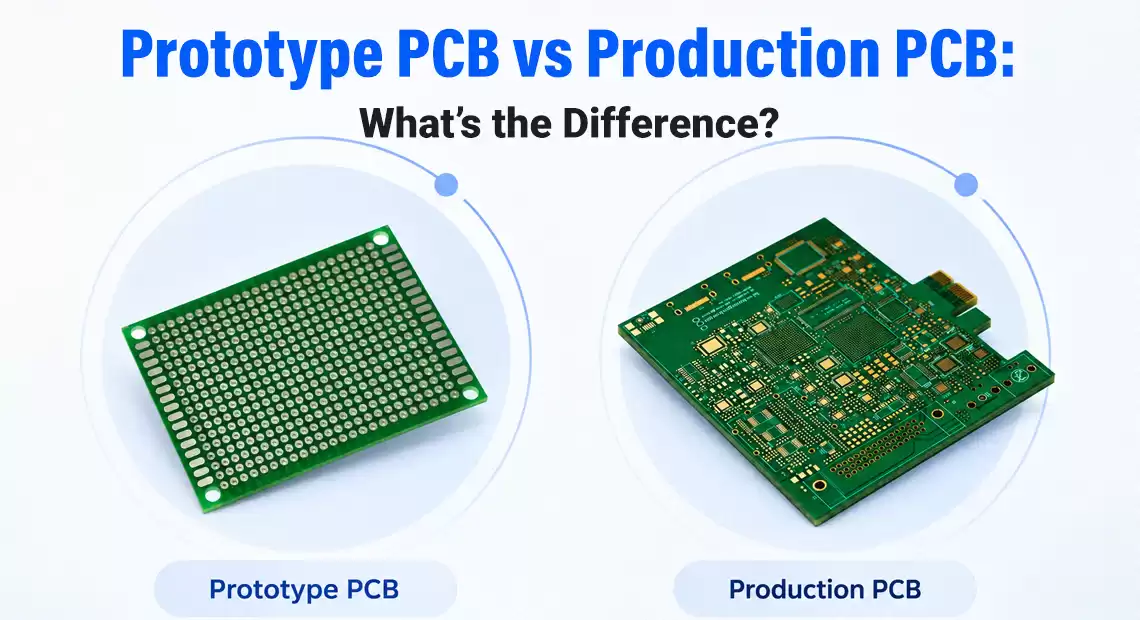
A prototype PCB and a production PCB can use the same Gerber design but require different manufacturing approaches based on order quantity, tooling, inspection and production requirements The difference isn’t the design. It’s the tooling, the volume math, the inspection method, and how much risk the manufacturer is willing to absorb per board.
If you’re deciding whether to order five boards or five thousand, here’s what actually changes and where engineers most often get the transition wrong.
The Core Difference: Tooling Investment vs Per-Unit Cost
Production PCB manufacturing may involve higher initial setup, tooling and panelisation costs, which can be distributed across larger order quantities to reduce the per-board cost, which are spread across larger production volumes. The trade-off is higher initial setup investment in exchange for improved production efficiency and lower per-unit costs at higher volumes, in exchange for a lower cost per unit once you’re running hundreds or thousands.
Prototype PCB manufacturing generally uses a more flexible setup to accommodate smaller quantities and design revisions while limiting initial setup costs.LDI can be used in prototype PCB manufacturing to create circuit patterns directly without conventional phototools, helping reduce tooling-related delays when design revisions are required, because LDI needs no film and no tooling lead time; a design change on day one doesn’t cost you a new phototool on day three. At PC Process, that’s the same LDI process used across our multilayer PCB manufacturing, up to 24 layers, which removes one of the biggest lead-time bottlenecks a tool process would otherwise introduce.
In short: prototypes optimise for speed and design flexibility. Production optimises for repeatability and cost per unit. Neither is a lesser version of the other; they’re solving different problems.
Prototype PCBs: Built for Discovery, Not Just Speed
Engineers often treat prototype PCBs as “the fast, cheap ones”. That undersells what a prototype run is actually for.
A prototype board helps identify potential manufacturing and design issues before volume production begins. These may include footprint mismatches, incorrect stack-up assumptions affecting impedance, or via placement that creates plating and manufacturability challenges.Catching these at 5 units costs a redesign cycle. Catching them at 5,000 units costs a scrapped inventory line and a very uncomfortable conversation with procurement.
What prototype runs typically include at PC Process:
- Free DFM (Design for Manufacturability) review before production, with engineer feedback provided according to the complexity of the design and review requirements.
- Low minimum order quantities, often single-digit board counts
- Fast-turn scheduling separate from the standard production queue
- Support for the same advanced constructions used in production: controlled impedance, blind and buried vias, heavy copper, Rogers/RF laminates
That last point matters more than it sounds. A lot of prototype shops can turn around a simple 2-layer board fast but can’t touch a 12-layer blind-via board on the same timeline. If your prototype needs the same stack-up complexity as your eventual production board, confirm the manufacturer can actually build that complexity at prototype volume, not just at scale.
Production PCBs: Where Consistency Becomes the Product
Once a design is validated, the priorities shift. Speed still matters, but consistency across every panel, every lot, every reorder six months later, matters more.
At the production stage, inspection methodology, process consistency and traceability become increasingly important alongside layer count and laminate selection. Sample-based inspection (checking one board per panel, or one panel per lot) is standard in a lot of the industry, and it’s fine for consumer electronics where a field failure means a warranty claim. It is not fine for a board going into a radar system or a patient monitor.
At PC Process, inspection and testing options are selected according to the board’s technical and quality requirements. Available processes include AOI, fly-probe electrical testing, impedance measurement, and CMI thickness checks, with 100% inspection available for qualifying orders. This standard is supported by ISO 9001:2015 quality management certification and LCSO approval under JSS 52302, India’s defence supplier qualification standard. Combined with in-house production from DFM through final test,that means a board built for a defence PCB customer carries the same documented test trail as a board built for a telecom customer’s field router.. That traceability is the actual product being sold at production scale, arguably more than the copper itself.
Prototype vs Production PCB: Side-by-Side Comparison
| Factor | Prototype PCB | Production PCB |
| Typical quantity | 1 to ~100 units | 100s to 1,000s+ units |
| Tooling | LDI, no hard tooling needed | Higher upfront tooling and panelisation setup |
| Turnaround | Faster, fast-turn queue | Longer, scheduled production run |
| Cost per unit | Higher | Lower, amortised across volume |
| Primary goal | Design validation, catch errors early | Repeatability, consistency, traceability |
| Inspection approach | Available on request, matched to requirements | Available on request, matched to requirements |
| Design flexibility | High, revisions expected | Low, changes require re-qualification |
Best Practices for a Clean Prototype-to-Production Handoff
- Lock your stack-up and material selection before the prototype build, not after, so validation data actually transfers
- Request the same inspection standard (AOI, fly probe, impedance testing) at the prototype stage that you expect at production, so you’re not discovering a new failure mode for the first time at volume
- Where possible, use the same manufacturer for prototype and production orders. This can help maintain DFM history, manufacturing records, drill data and agreed process parameters during the transition to volume production.
- Ask for CMI thickness and impedance test reports on the prototype run itself, so you have a documented baseline to compare against production lots
Key Takeaways
Prototype and production PCBs serve different purposes: prototype manufacturing validates the design, while production manufacturing focuses on repeatability, process consistency and quality at scale. The manufacturing method (tooling, inspection depth, in-house control) should match the reliability requirement of the end application, not just the order quantity.
If your design has cleared prototype validation and you’re planning the move into a production order, the questions that matter most are whether your stack-up carries over unchanged and whether your inspection standard holds at volume. Talk to our engineering team about your specific transition, or upload your Gerber files for a free DFM review before you commit to a production tooling run.
Frequently Asked Questions.
- What is the main difference between a prototype PCB and a production PCB?
A prototype PCB validates a design at low volume using flexible tooling like LDI. A production PCB involves higher upfront tooling and panelisation setup to deliver consistent, repeatable boards at scale. - Can a prototype PCB use the same materials as the production version?
Yes, and it should. Using the same laminate, copper weight, and stack-up at the prototype stage ensures impedance and thermal validation data actually applies to production. - How long does prototype PCB manufacturing typically take?
Prototype turnaround can be significantly shorter than a conventional tooled production run, depending on the board’s complexity and current production capacity. - Does inspection quality change between prototype and production PCBs?
Inspection requirements depend on the board’s complexity, application and customer specifications. At PC Process, available inspection options include AOI, fly-probe electrical testing, impedance measurement and CMI thickness checks, with 100% inspection available for qualifying orders. - Why do production PCBs cost less per unit than prototypes?
Production runs amortise tooling and setup costs across hundreds or thousands of units, while prototype runs carry that setup cost across just a handful of boards. - Can complex constructions like blind vias or controlled impedance be prototyped?
Yes, provided the PCB manufacturer supports these construction requirements at prototype volumes. Confirm material availability, layer count, via technology, impedance requirements and inspection capabilities before placing the order. - What should I check before moving from prototype to production PCB manufacturing?
Confirm stack-up and material consistency, request a second DFM review for panelisation, and ask what inspection standard applies at a production scale. - Is it better to use the same manufacturer for prototype and production PCBs?
Generally yes. It preserves DFM history, drill programs, and process parameters, reducing the risk of unexpected variation when scaling up. - What industries require full traceability from prototype through production?
Industries such as defence, aerospace, medical electronics and automotive may require detailed manufacturing records and traceability, depending on their quality standards, application and customer specifications. - How many boards typically define a “prototype” order versus “production”?
Prototype orders commonly involve small quantities, while production orders involve larger repeatable volumes. There is no fixed quantity that defines the transition; it depends on design validation, manufacturing readiness and project requirements.


